• Turn Data Into Answers, Fast
  • AI That Understands Your Business
  • Scale Insights to Every Leader

Side by side

Larridin vs One Model: How They Compare

Both measure AI at work. They start from different places: Larridin from AI spend and usage, One Model from the workforce and the work itself. One Model is a Larridin competitor worth considering. 

  Larridin One Model
Built to answer What AI costs, who uses it and what teams produce with it, with a strong engineering focus How your people actually use AI, how well, and how their work is changing
How data arrives A browser extension and desktop application deployed centrally to employee computers. Computer-based, so iOS usage isn't tracked APIs and telemetry from your AI vendors, Microsoft Graph and your data lake, joined to your HR systems
What the work was Summary statistics on tools used and broad use categories Work classification at prompt level: the tasks, outputs and workflows AI supports. Switch prompt content on or off by policy
Quality of AI use Proficiency benchmarked by team and location Capability for each person and team: prompting, delegation, rework and resolution
Workforce context HRIS and identity connectors to map usage to teams A governed workforce model built since 2014: org structure, roles, managers, cost, performance, hiring and retention
Work outcomes Estimated capacity value from hours and spend, plus engineering output metrics AI-supported work joined to productivity, performance, retention and business results, with every value estimate labelled and its assumptions shown
Employees and managers Dashboards for leaders, with visibility configured by team A private view for every employee, and coaching plays with a conversation opener for every manager
AI spend Deep token, seat and model spend tracking Spend, licenses and waste, tied to the work that spend produced
Security SOC 2, HIPAA and GDPR compliant; on-premises option on Dell and HP appliances ISO 27001:2022 and SOC 2 Type II certified; GDPR data processor

Larridin details are taken from Larridin's public website and FAQ as of 16 November 2026. Products change; if anything here is out of date, tell us and we'll correct it.

Measuring AI effectiveness without surveillance

Trusted with the most sensitive data in the enterprise since 2014

One Model was founded by the team behind Infohrm, later part of SuccessFactors and SAP, who worked with hundreds of HR analytics teams. For more than a decade we've modelled pay, performance, exits and succession data for large organizations. AI usage data deserves the same care.

Private by default

Each employee sees their own AI picture first. Managers and leaders see the patterns their role allows. AI Impact is built for coaching, not employee monitoring.

You set the rules

Turn prompt-level reporting on or off by company policy, and exclude employees in locations where local rules require it.

Governed like your HR data

Role-based access and the same governance that already protects your people data. You keep full ownership, access and control.

Independently certified

ISO 27001:2022 and SOC 2 Type II certified, operating as a GDPR data processor.

One Model AI Impact

AI usage is where it starts. Work outcomes are the point.

Adoption tracking and spend data can tell you AI is being used. For true AI ROI measurement, you need to join it to who did the work, what the team is for, and what changed as a result. That's the data One Model already holds thanks to our expertise in workforce analytics.

1. See the activity

Usage, licenses, tokens, spend and prompt-level work classification across OpenAI, Anthropic, Microsoft, Google Gemini, xAI, Glean and custom systems.

2. Add workforce context

Read AI use by team, role, function, manager and cost center, so you can compare like with like.

3. Connect to work outcomes

Join AI-supported work to productivity, performance, retention, hiring and business results from Workday, SuccessFactors, Oracle, Greenhouse, Qualtrics and your data lake, for true AI impact measurement. 

How work is transforming

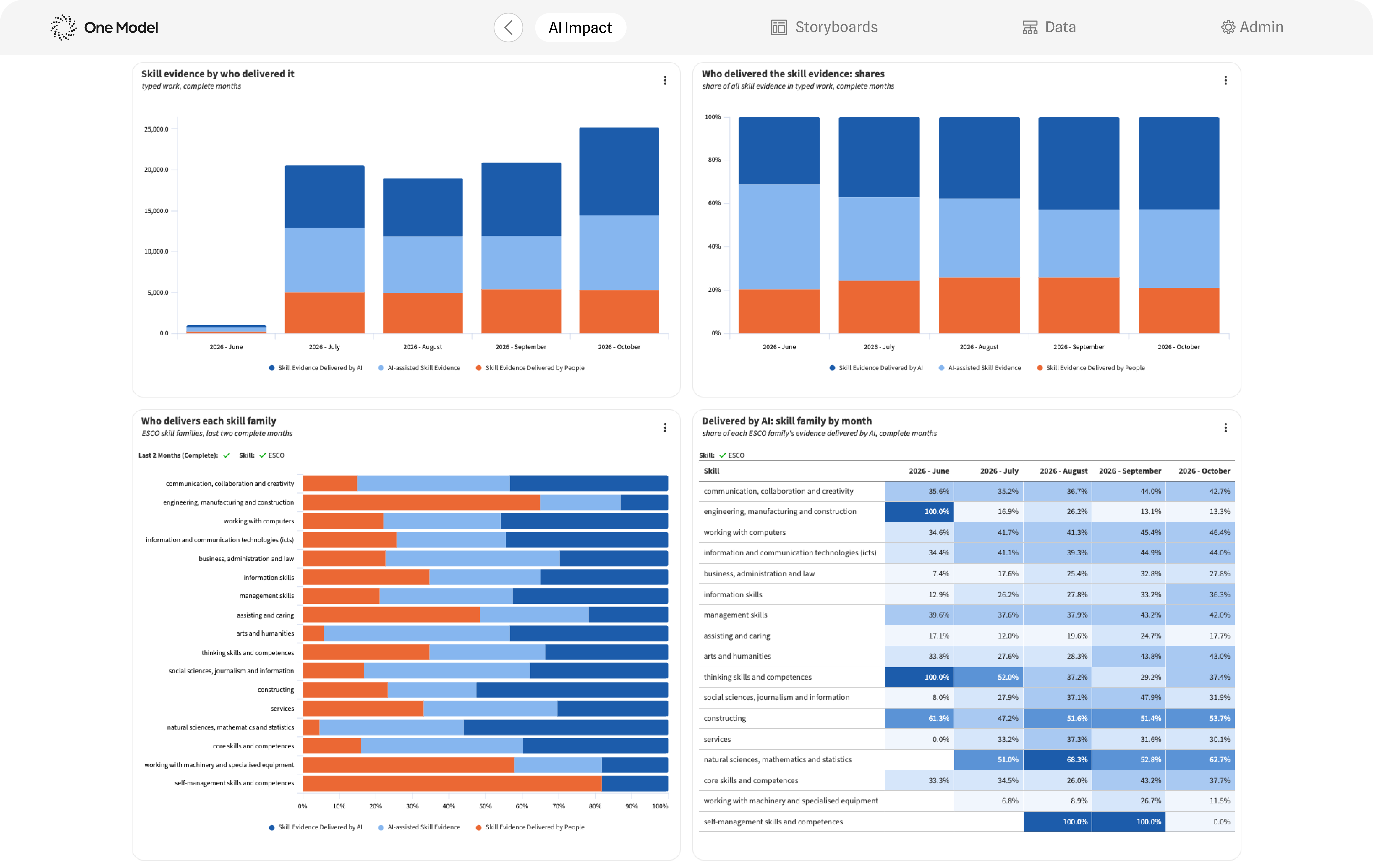
See how work changes in real time, not just how often AI is opened

Usage counts plateau. The work underneath keeps moving. One Model AI Impact tracks which tasks, activities and skills AI supports, how that shifts team by team, and where each manager should coach next. It shows you: 

  • Which work AI now does, and which work people still do by hand
  • Who has moved from simple prompting to real delegation, and who is stuck in rework
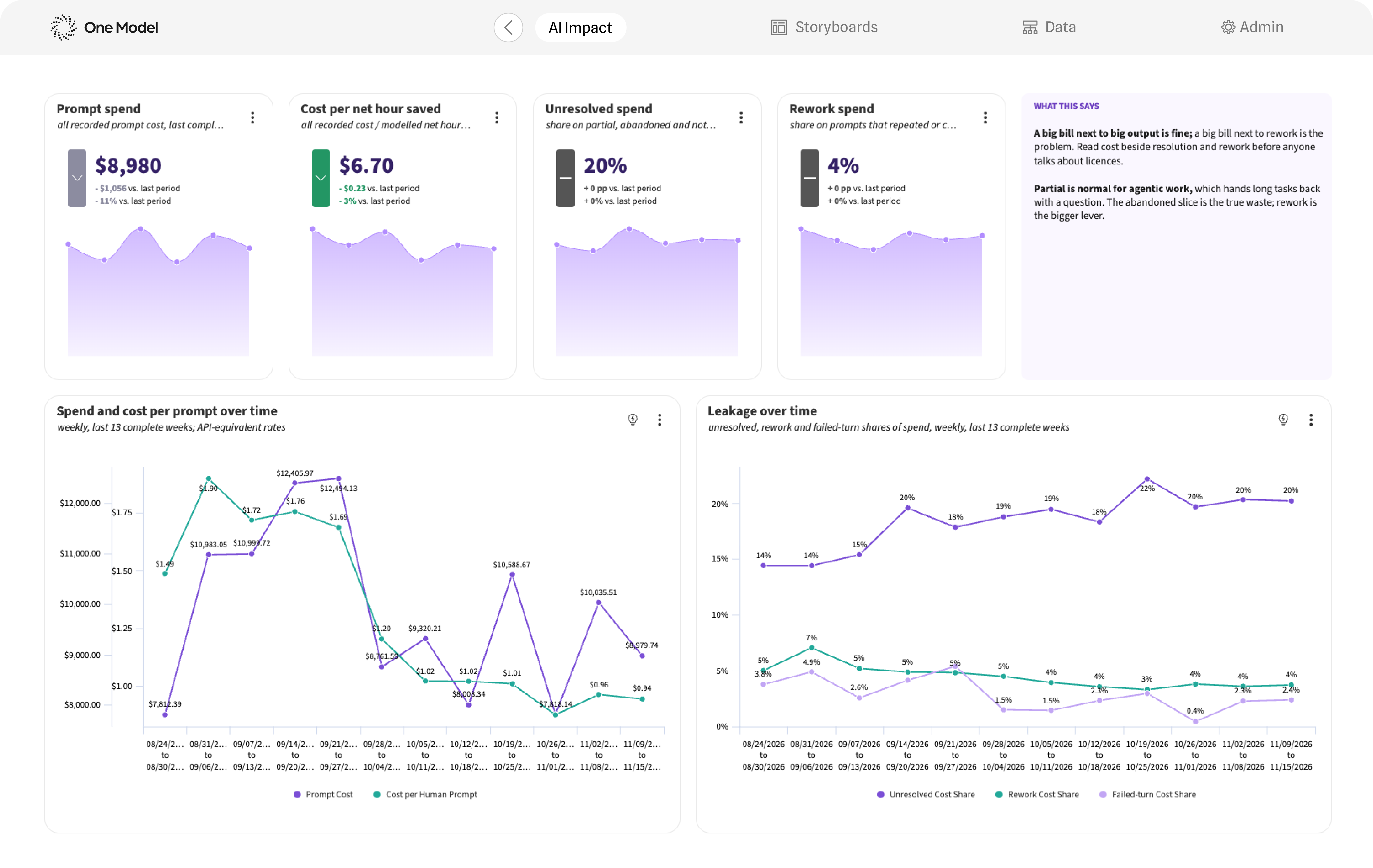
  • Where AI spend turns into finished work, and where it leaks

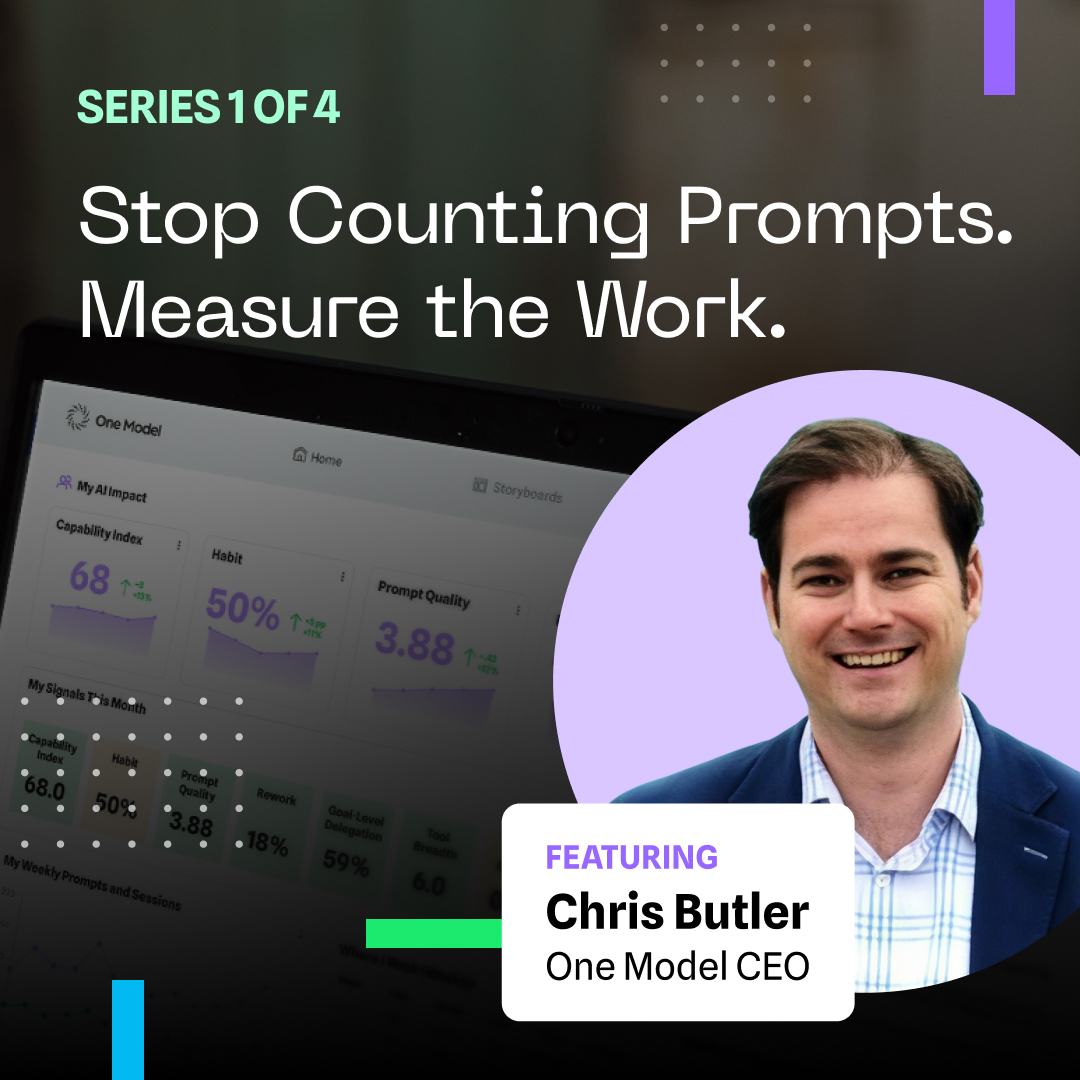
"Our AI usage numbers went flat for months. Underneath that flat line, the way our work got done changed a lot."
Chris Butler, CEO, One Model

Stop counting prompts. Measure the work.

When Larridin is the better fit

Larridin is a strong choice if your main question is AI spend: token, seat and model costs, coding-agent analytics for engineering teams, or browser-level discovery of AI tools IT hasn't approved.

If you need to know whether AI is changing how your people work, what that means for performance, cost and capability in every function, and how managers should act on it, that's what One Model is built for. You'll still need to compare Larridin pricing to One Model's and see which makes more sense for your organization. Be sure to check Larridin reviews and case studies as well, to make an informed decision on your future AI productivity measurement tool. 

Exploring Larridin Alternatives? 

Larridin and One Model AI Impact both help enterprises understand AI adoption, usage, spending, and workflows. One Model goes further, connecting AI activity with workforce data to measure how AI is transforming work, quantify productivity gains, and translate those improvements into measurable financial ROI.

Beyond tracking AI investments, One Model helps organizations understand the value AI tools deliver across teams and individual roles, identify opportunities to improve employee adoption and effectiveness, and uncover where additional AI investments can drive greater returns.

Compare One Model AI Impact and Larridin to discover a more complete approach to AI impact measurement, workforce productivity, and ROI.

See One Model AI Impact in Action

Go beyond AI usage and spending to see the measurable impact of AI across your workforce. One Model AI Impact connects AI adoption, productivity, and business outcomes to help you quantify financial ROI, understand how teams and individuals are benefiting from AI, and uncover opportunities to improve effectiveness and maximize your AI investments.

Go beyond usage metrics

One view across every AI tool you pay for, with the context to understand usage, effectiveness, and value.

Go beyond usage metrics

One view across every AI tool you pay for, with the context to understand usage, effectiveness, and value.
Understand the work

Prompt-level intelligence reveals the tasks, outputs, and workflows AI supports, from quick requests to deeper, iterative work. See where AI fits into daily work and where it does the heavy lifting.

Build AI capability

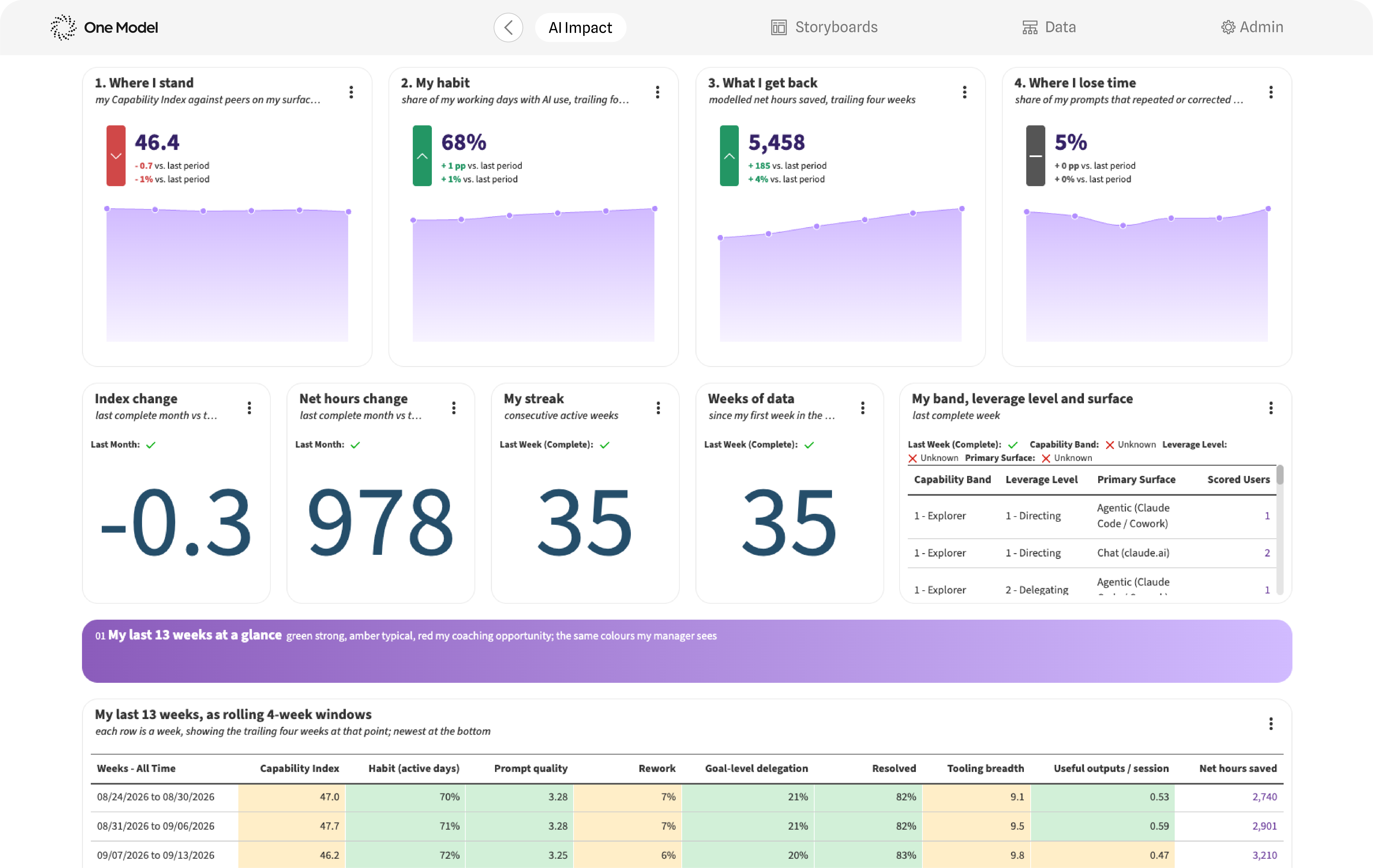
Give employees a private view of their own AI habits, capability, and delegation. Help them see where stronger prompting, clearer handoffs, or better workflows can improve effectiveness.

Turn insights into action

Surface the patterns managers can act on, with clear coaching opportunities and a script to open the conversation. Know what to discuss, what to try, and what to check next.

Prove the value

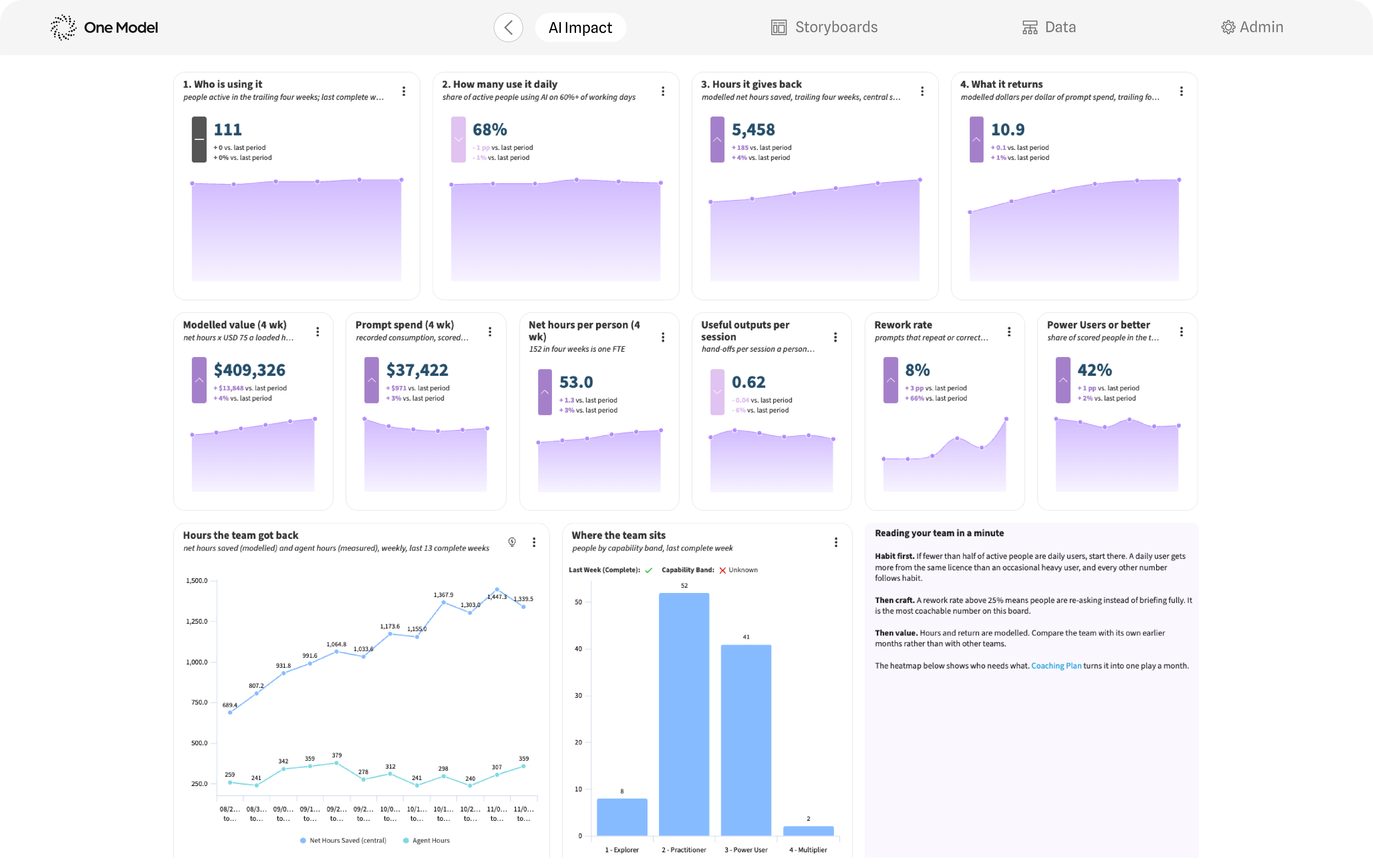
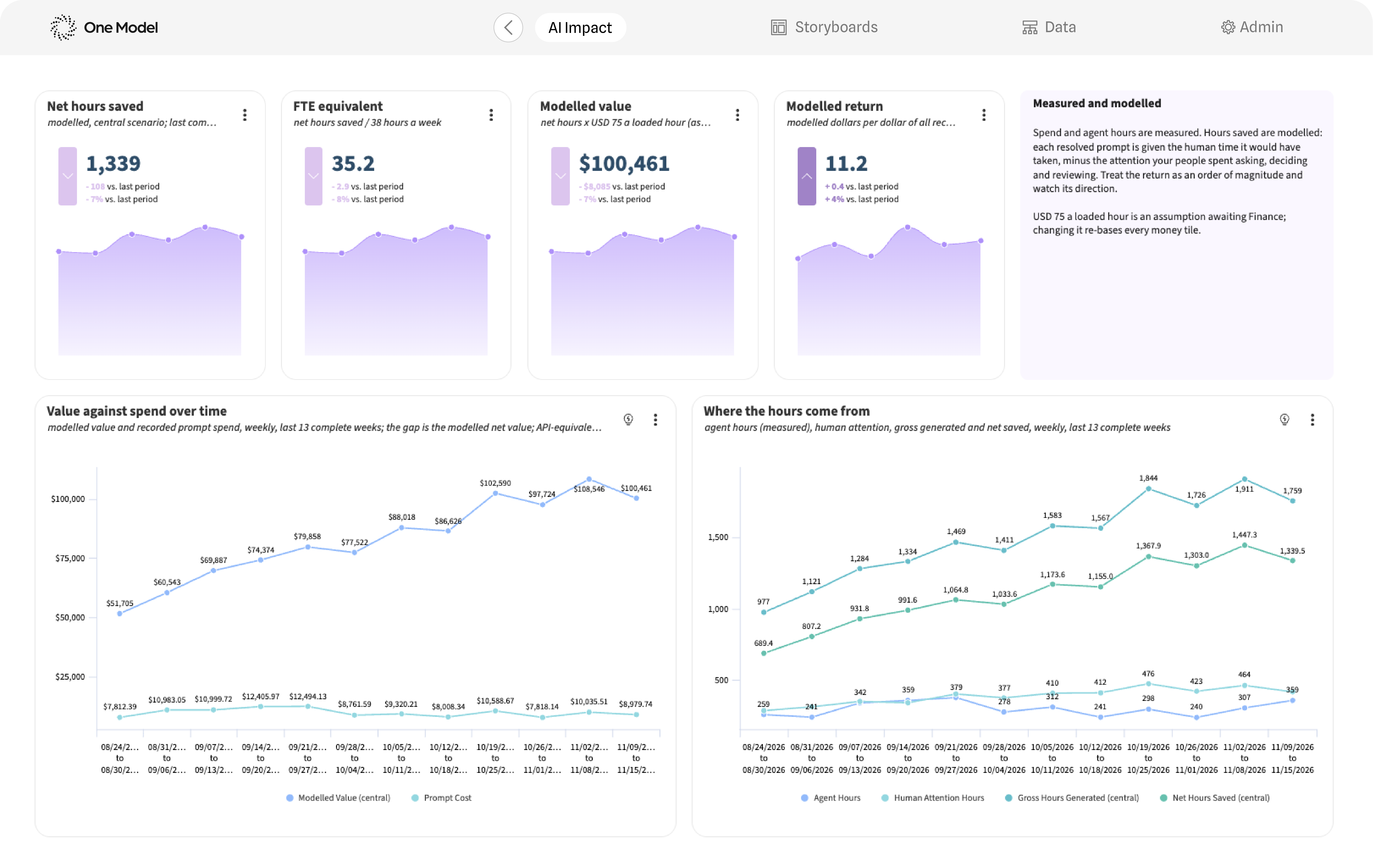
Measure the financial impact of your AI investment. Track modeled hours saved, financial value, and return alongside AI spend to see the value your organization is generating.

See how work is changing

Discover how AI is changing work across your organization. Explore which tasks, activities, and skills AI supports, how work is shifting between people and AI, and how those patterns evolve over time.

Improve cost efficiency

Find opportunities to reduce unnecessary AI spend and improve efficiency. Track prompt costs, cost per net hour saved, rework, and unresolved tasks to identify where investments could deliver greater returns.
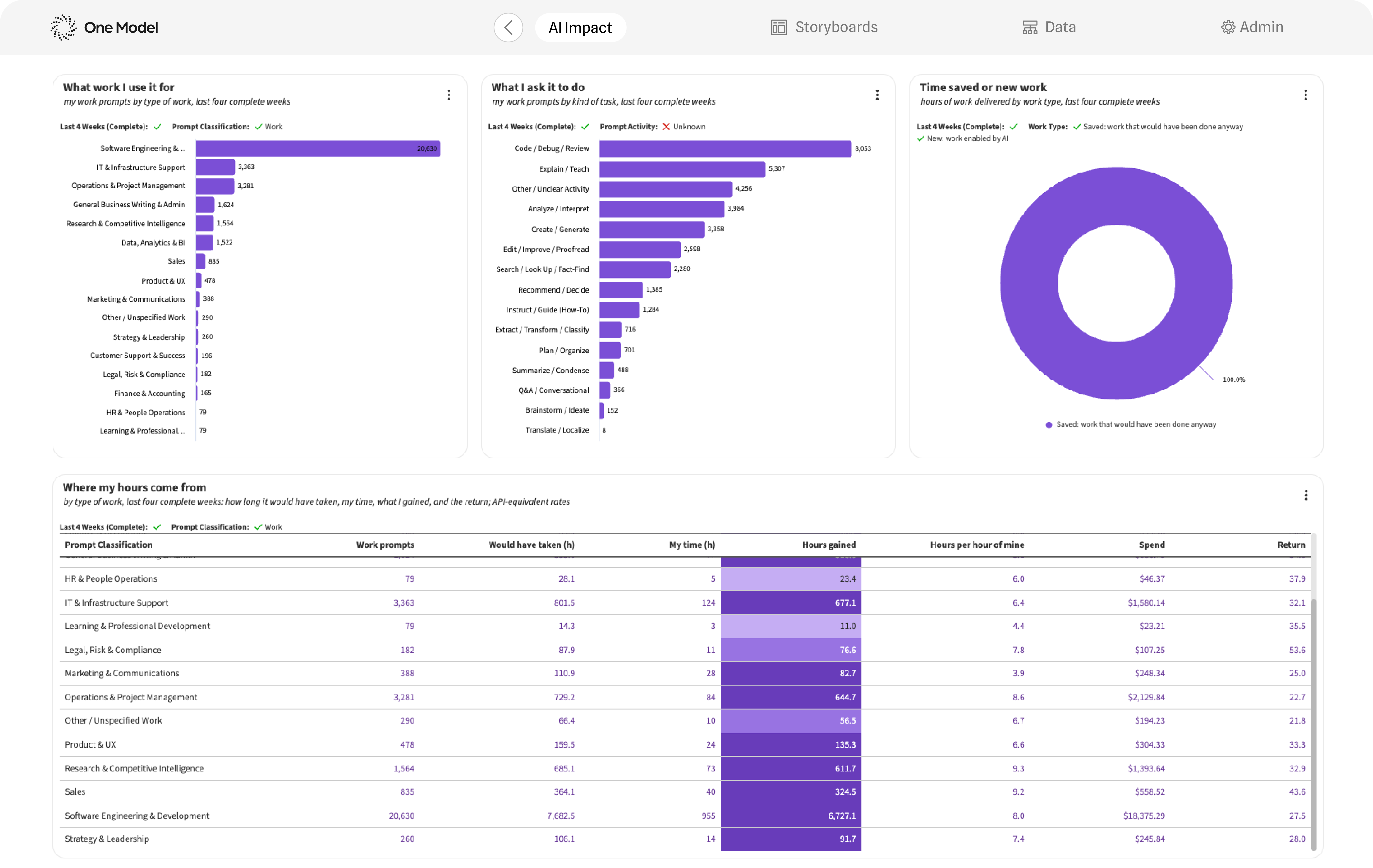
Understand the work R3
Build AI Capability R3
Turn insight into action R3
Prove the value R3
See how work is changing R4
Improve cost efficiency R3

FAQs

Yes. One Model AI Impact is a Larridin alternative for enterprises looking to measure AI adoption, usage, spending, productivity, and financial ROI. Beyond AI activity tracking, One Model connects AI usage with workforce context, work classification, employee capabilities, and business outcomes to help organizations understand where AI creates measurable value and where teams can improve.
AI usage tracking measures which tools employees use, how frequently they use them, and associated spending. AI effectiveness measurement goes further by examining how AI contributes to work quality, productivity, completed tasks, and business outcomes. Two employees with similar AI usage may generate very different results. One Model AI Impact helps organizations understand those differences and identify opportunities to improve AI effectiveness.
One Model AI Impact is designed with employee privacy and enterprise data governance in mind. Individual insights are private to employees by default, while managers and leaders receive access based on their permissions. Organizations can control prompt-level reporting through company policies and exclude employees in specific locations. One Model is ISO 27001:2022 and SOC 2 Type II certified.
No. One Model AI Impact can operate independently using AI telemetry data. Connecting HR systems adds workforce context, including performance, retention, roles, and organizational structure. This allows enterprises to connect AI adoption and productivity measurement with broader workforce and business outcomes. Existing One Model customers can build on their established people analytics foundation.
One Model AI Impact supports data from OpenAI, Anthropic, Microsoft, Google Gemini, xAI, Glean, and custom enterprise AI systems. Integrations can use APIs, telemetry feeds, Microsoft Graph, and data lake sources. Available AI adoption tracking and measurement capabilities depend on each provider's plan, data availability, and configuration.
Yes. Organizations can use One Model AI Impact alongside AI spend management and cost optimization tools. While spend tools help manage token budgets, licenses, and AI expenses, One Model connects AI usage and investment data with workforce productivity, employee capabilities, and business outcomes to provide a broader understanding of AI effectiveness and financial ROI.
AI ROI measurement connects the cost of AI investments with measurable business value, including productivity improvements, time savings, and work outcomes. One Model AI Impact combines AI usage data with workforce context to help organizations quantify the financial impact of AI across teams and roles. This helps leaders understand where AI investments deliver value, identify opportunities for improvement, and make more informed decisions about future AI spending.
One Model AI Impact measures AI productivity by connecting tool usage with work classification, employee capabilities, workforce context, and business outcomes. Rather than relying only on logins or prompts, organizations can understand how AI supports work, where productivity improvements occur, and which teams or roles have opportunities to increase effectiveness. These insights help leaders identify training needs, improve AI adoption, and measure the impact of AI on workforce performance.
When evaluating Larridin competitors, enterprises should consider more than AI usage tracking and spending visibility. Important capabilities include AI adoption measurement, productivity insights, financial ROI, workforce context, employee privacy, and enterprise data governance. One Model AI Impact brings these capabilities together to help organizations understand how employees use AI, quantify its impact on work and business value, and identify opportunities to improve adoption and returns.
See how your people actually use AI

Bring one team. We'll show you what work AI is doing, how well it's being used, and how that work is changing, joined to the workforce data you already trust.