


 Overview
 One AI
 Data Mesh
 One AI Assistant
 Data Stories
 Enterprise AI
 One AI Data Intelligence


 Overview

 Employee Engagement
 Talent Retention
 HR Dashboards
 Succession Planning
 Talent Acquisition
 Workforce Analytics
 Case Studies
 Whitepapers
 Blog
 Events & Webinars
 Product Innovation Blog
 Roles in People Analytics
 Contact Us
 Partners
 About Us
 Careers
 News
 Why One Model

Most enterprises can already answer the easy question about AI: who has access to it. Seats are provisioned, logins are tracked, and someone on the leadership team can pull up a dashboard showing how many employees used ChatGPT, Copilot, or Claude last month.
What most enterprises can't answer yet is the harder question underneath it. Is that usage actually going anywhere? Are the people using AI every day using it effectively, or are they clicking through a tool once a week and calling it adoption?
That gap is why AI adoption metrics matter, and why so many organizations are getting them wrong. Adoption metrics are the starting point for understanding AI in the workforce, not the finish line. Treated as the finish line, they tell leaders a comfortable story that usage is high, without ever answering whether that usage is doing anything for the business.
This post walks through the AI adoption metrics worth tracking, how they differ from AI usage analytics, and why adoption numbers on their own can't stand in for AI effectiveness or AI ROI.
What Are AI Adoption Metrics?
AI adoption metrics are the measurements that show how widely and consistently employees are using AI tools across an organization. They typically cover license activation, login frequency, active usage over time, and which roles or departments are using AI at all. Adoption metrics answer an access question: who is using the tool, and how often.
Why Track AI Adoption Metrics in the First Place?
Adoption metrics matter because they are the only honest starting point for an AI rollout. Before an organization can ask whether AI is working, it has to know whether people are actually using it. A tool with low adoption can't be producing much value, no matter how good it is.
Adoption data also surfaces real operational problems early. A team with near zero logins after a licensing push is telling leadership something: the training did not land, the use case is not obvious yet, or the tool does not fit how that team actually works. Catching that in month one is far cheaper than discovering it during a renewal conversation a year later.
The mistake is stopping here.
Adoption metrics are necessary, but they describe presence, not performance.
The Core AI Adoption Metrics Enterprises Should Measure
A useful adoption picture usually includes the following:
- License and seat utilization: What percentage of provisioned seats are actively being used, versus sitting idle as shelfware.
- Active usage frequency: How often a user engages with the tool: daily, weekly, or only once after onboarding.
- Usage depth by role and team: Whether adoption is concentrated in a few functions or spread across the organization, and whether that distribution matches where the work actually is.
- Feature or use case breakdown: Which capabilities people are actually using, such as drafting, summarizing, coding, or analysis, rather than a single undifferentiated usage number.
- Usage consistency over time: Whether adoption is growing, flat, or quietly declining after an initial launch spike.
- Cross tool usage patterns: How adoption compares across the different AI platforms an organization has licensed, since most enterprises are running more than one.
Each of these is a useful signal on its own. But none of them, individually or together, tells you whether AI is making the work better.
AI Adoption Metrics vs. AI Usage Analytics: What Is the Difference?
These two terms get used almost interchangeably, but they describe different layers of the same problem. Adoption metrics are typically the headline numbers: seats activated, logins, weekly active users. AI usage analytics go one level deeper, breaking usage down by activity type, session length, and patterns within a role or team.
In practice, usage analytics are what most AI platform vendors expose natively inside their own admin dashboards. That native data is a reasonable place to start, but it’s built around a single tool. It can't tell you how usage of Copilot compares to usage of ChatGPT across the same team, and it has no visibility into the workforce context, like role, manager, or cost center, that turns a usage number into a business insight.
Why AI Adoption Metrics Are Not the Same as AI ROI
This is the distinction that trips up most AI reporting today.
High adoption is often treated as proof that an AI investment is paying off.
It’s not, and conflating the two leads to decisions made on an incomplete, misleading picture.
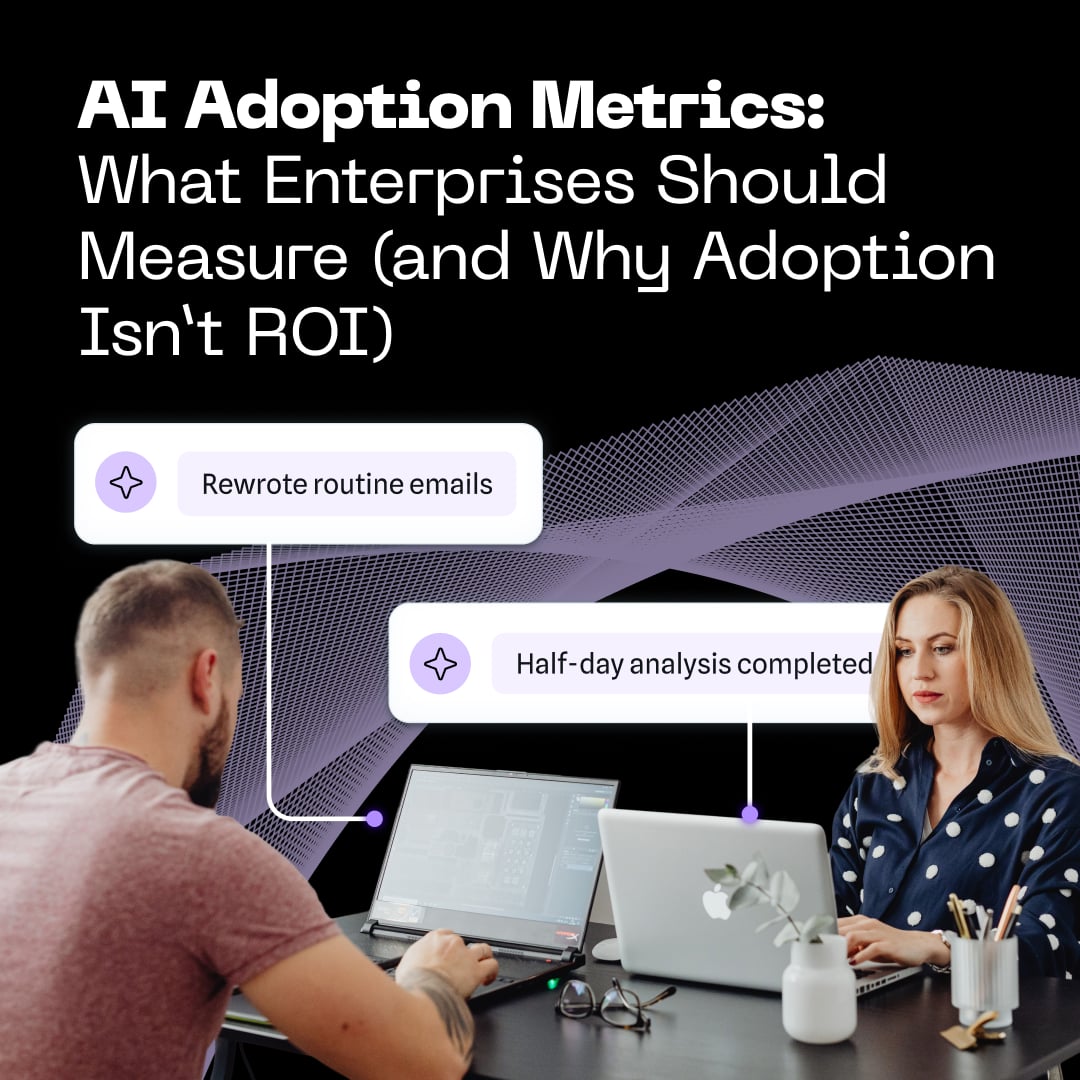
Two employees can show identical adoption numbers, same daily logins, same number of prompts, and be getting completely different value out of the tool. One might be using AI to summarize documents. The other might be using it to research, draft, and refine a piece of analysis that previously took half a day. Adoption metrics can’t tell those two people apart. Only a measure of what the work actually was, and what happened to it, can.
AI ROI requires connecting adoption to outcomes:
- Time saved
- Rework avoided
- Tasks completed
- The dollar value of all of it compared to what the tool costs
Adoption is an input into that calculation. It’s not the calculation itself.
Enterprise AI Adoption: What Changes at Scale
Adoption measurement gets harder, not easier, as an organization scales. A pilot group of fifty people using one AI tool is simple to track by hand. An enterprise running several AI platforms across thousands of employees in dozens of functions is not.
At scale, three problems show up consistently:
- Adoption data lives in separate silos, one dashboard per vendor, with no shared view across tools.
- Raw usage counts stop being meaningful without workforce context, since a login from an engineering team and a login from a sales team represent very different kinds of work.
- Leadership starts asking for a single, defensible number, and stitching one together manually from several vendor exports becomes its own part time job.
To combat these issues, enterprise AI adoption measurement has to go deeper than mere adoption. It needs to:
- Centralize usage data across every AI platform in use, rather than relying on each vendor’s own dashboard in isolation.
- Attach workforce context, role, team, manager, and cost center, to every usage record so adoption can be sliced the way the business actually operates.
- Enable the periodic review of adoption trends, not just a one-time launch report, since adoption that looks healthy at ninety days can quietly erode by month six.
- Dig deeper into prompts to give a more nuanced view of the type of work employees are doing, and whether their proficiency is improving.
- Treat adoption as the entry point into a larger measurement model that also covers productivity, effectiveness, and ROI, rather than the final report leadership sees.
Organizations that stop at step one end up with a dashboard full of green numbers and no real answer when someone asks whether the investment was worth it.
How to Go Beyond Adoption Data
Adoption tells you that people are using AI. One Model AI Impact is built to show you what they’re using it for.
It uses prompt-level intelligence to analyze the work behind the AI usage. Are employees drafting documents, writing code, doing research, or composing communications? It joins that analysis with the governed workforce data and context that One Model is known for. The platform also pulls usage from across your AI platforms into one governed view, so you’re not comparing vendor dashboards by hand. That’s the difference between “Finance logged in 400 times” and “Finance is using AI for analysis and reporting, with multiple power users and dozens who would benefit from pointers.”
Because prompts can contain sensitive information, privacy is built in. Prompt-level intelligence can be switched on or off at the company or user level, and role-based security controls who sees what, from individual to aggregate. Adoption is your starting metric. With One Model AI Impact, it stops being your only one.
Ready to move beyond usage dashboards?
Frequently Asked Questions
