

 Overview
.svg) One AI
One AI
 Data Mesh
.svg) One AI Assistant
One AI Assistant
 Data Stories
 Enterprise AI
 One AI Data Intelligence


 Employee Engagement
.svg) Talent Retention
Talent Retention
-1.svg) HR Dashboards
HR Dashboards
 Succession Planning
.svg) Talent Acquisition
Talent Acquisition
 Workforce Analytics
 Why One Model
-2.svg) Whitepapers
Whitepapers
 Blog
Blog
-2.svg) Events & Webinars
Events & Webinars
.svg) Product Innovation Blog
Product Innovation Blog
-1.svg) Roles in People Analytics
Roles in People Analytics
.svg)
 Contact Us
-3.svg) Partners
Partners
 About Us
-3.svg) Careers
Careers
-1.svg) News
News
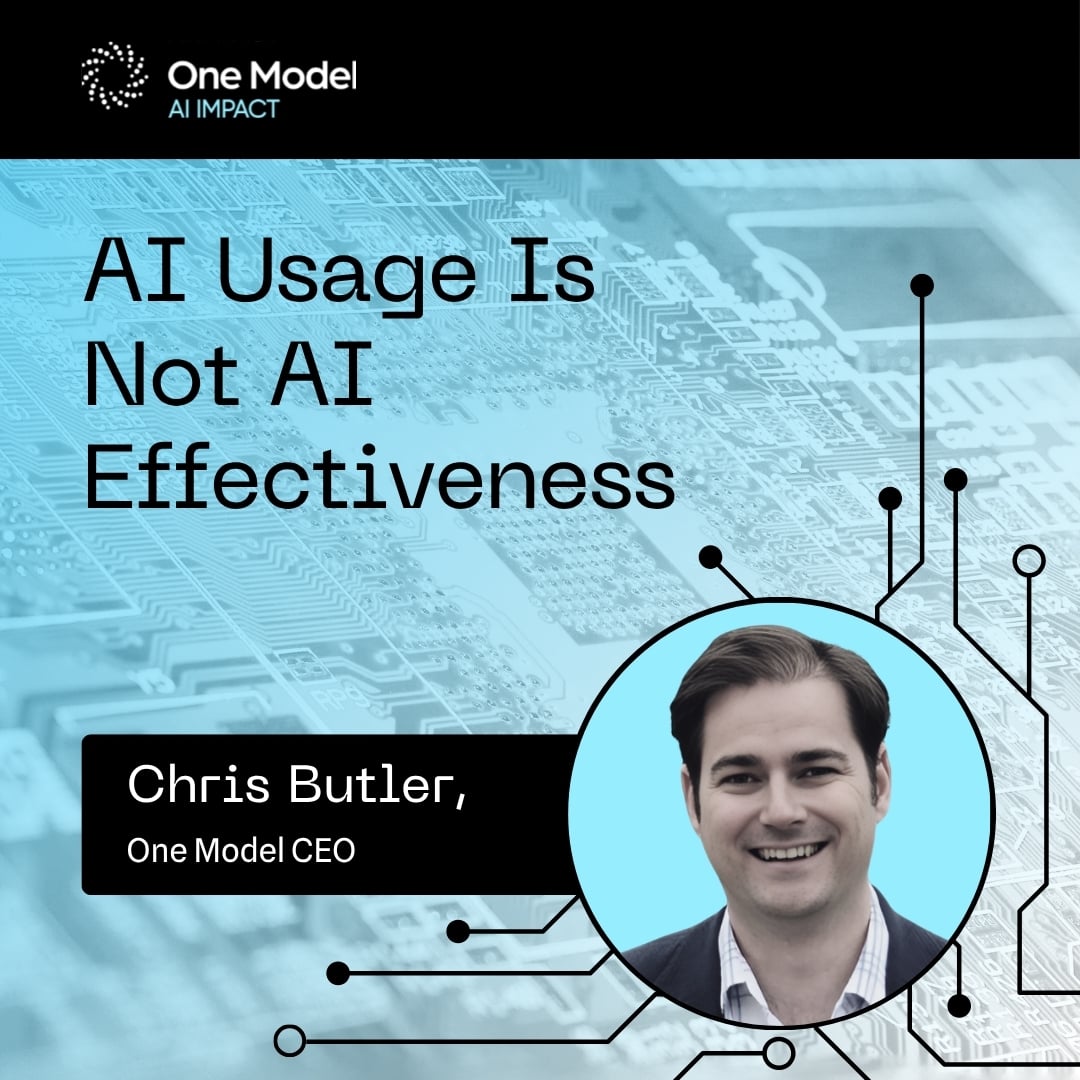

We gave everyone at One Model access to AI. It's the biggest productivity tool we've put in front of our people in years, and I want every one of them to get real value from it.
That raised the obvious next question: is it actually changing how work gets done, and is it worth what we're paying for it?
Not whether people log in. I could see that on day one. I wanted to know what kinds of work AI was helping with. Where it had stuck, and where people hadn't yet found a use for it. And what the teams getting the most out of it were doing differently, so everyone else could learn from them.
None of our tools could tell me that. They showed seats, logins and tokens. That's activity, not effectiveness.
82%
of senior technology buyers say understanding AI's impact on productivity remains a significant or critical challenge.
So we built a way to see it. That's AI Impact, which we're announcing today. The announcement covers the mechanics. This post is about why the question matters, and why most organizations can't answer it yet.
Usage is not effectiveness
Most AI reporting stops at adoption. Seats provisioned. Weekly active users. Tokens consumed. Cost per seat. Those are the right places to start. They're the wrong places to stop.
Adoption tells you people have the tool. It doesn't tell you whether anything changed. The same tool can save one team a day a week and barely touch another. On an adoption dashboard, they look identical.
The difference shows up in three places:
What kinds of work people bring to AI
How well that maps to the work the team exists to do
What happens after
That's harder to see, and it's been difficult to measure it.
How we measure it
AI Impact measures the three things adoption dashboards miss. It does it by connecting three kinds of data: what the AI tools record, what the work was, and who was doing it.
What kinds of work people bring to AI. Every prompt is graded automatically by business function and activity, by how complex/valuable it is, and by how much of the task was handed to the AI.
How well that maps to the team's work. Each prompt is joined to workforce data: the person's role, team, manager and cost center. That's what shows whether AI is going to the work the team exists to do.
What happens after. We measure whether the task was resolved or had to be redone, how long the AI worked on it, and how much time people spent directing and reviewing it. Where we connect them, we follow the work into the systems where it lands, such as Jira and the CRM.
From there we build a productivity ledger: the time each resolved task would have taken a person, minus the time people spent getting it done with AI. Hours saved are valued at a loaded hourly rate and set against what the AI cost, with conservative and generous cases shown beside the central one.
The same data is then shown three ways. Employees see their own picture. Managers see their team's, against a company benchmark. Leaders see cost, return and where the value is. All of it sits under the same role-based security as the rest of the people data.
What we saw when we looked at ourselves
We ran AI Impact on our own company first: about 100 people, all using Claude. Six things stood out.
Teams look alike. People don't. Averaged by team, AI skill looks almost identical across the company. Inside each team it varies a lot. Most of the variation in capability sits between people in the same team, not between teams. In one nine-person team, rework ranged from 5% to 23% of prompts. Where teams do differ is habit: 95% of one team use AI on most working days, against 20% of another.
Rework is the biggest cost leak. About 17% of our AI spend went on rework, prompts spent correcting or redoing earlier output. It was worst in drafting work: marketing content (30%), planning (29%) and customer communications (26%). Engineering work was lower, at 19 to 23%. And it fell steadily as prompts got better, which makes it something you can coach.
Spend is heavily concentrated. Platform engineering was 52% of work sessions but 80% of cost. Refactoring alone was 4% of sessions and 19% of cost. Sales work was 10% of sessions at 2% of cost. Depending on the tool, a single session cost anywhere from about USD 2 to USD 40.
Premium models do a lot of easy work. They took about 80% of our spend. Moving the simplest tasks to a cheaper model could save significant amounts per week.
People approve almost everything agents propose. Our people approved 99.6% of the actions AI agents proposed. That may mean trust has been earned. It may mean people have stopped checking. You need to know which.
What it's worth. In the last complete week, our 100 people measured saved an estimated 2,174 hours of work. At a 38-hour week, that's the equivalent of 57 additional full-time people, in a company of about 100. We spent USD $12,384 on AI consumption that week, or USD $5.70 for every hour saved. Valued at USD $75 a loaded hour, those hours were worth about USD $163,000: a return of 13 times the spend, and about USD $150,000 net. Across the last four weeks the picture holds: about 7,200 hours, an average of about 47 FTE, and a return of 11.5 times.
Hours saved is a modeled figure. It starts from what each piece of work would have taken a person, then subtracts the time our people spent directing and reviewing the AI. The spend is consumption only, not seat licenses. We show the work because a number without its assumptions is a guess.
2,174
estimated hours saved
in one week
$5.70
AI consumption cost
per hour saved
13x
return on AI spend
in that week
None of this shows up on an adoption dashboard. Every one of these findings came from connecting what AI was doing to who was doing it and what the work was for.
AI transformation is a workforce transformation
AI is the biggest change to how work gets done that most of us will see in our careers. Yet most organizations are running it like a software deployment. Buy the licenses. Provision the seats. Run the training. Track adoption.
That work matters, and most IT teams have done it well. But a technology rollout is finished when the software is live. A workforce transformation is finished when the work has changed. The second one needs different measures, and it isn't owned by any single function.
Managers drive transformation
Every workforce change that has actually stuck has been driven by managers. Not by the vendor, not by a central program, and not by a memo from the CEO.
Managers decide what work their team takes on and how it gets done. They're the ones who can show someone how to hand a real task to AI, make time for people to learn, and make it normal rather than optional.
Most managers are being asked to lead this blind. They get a license count and a training calendar. They don't know what work their team is using AI for, where it's helping, where it has stalled, or what teams elsewhere in the company are doing differently.
Our own data makes the point. Most of the variation in how well people use AI sits inside teams, not between them. That's a problem only a manager is close enough to solve.
Give managers that picture and they can coach. Without it, they're guessing.
That's where we've focused AI Impact. Managers see how AI is showing up in their team's work, how that compares with the rest of the company, and practical ways to help their people get more from it. Employees see their own picture first: how they use AI, where they're getting value, and how to get better.
If managers are the engine of AI transformation, the tools have to be built for them.
The missing half of the picture
Today, the AI picture is split in two.
IT and operations teams see the tools: usage, cost, licenses, tokens, which models are being used and where. HR and people analytics teams hold the workforce data: roles, teams, managers, skills, and how the organization is changing. Neither half can answer the effectiveness question on its own.
AI tools know about prompts and tokens. They don't know who's asking. They don't know the person's role, team or manager, or what that team is meant to produce. Without that, you can count AI activity, but you can't explain it.
People analytics teams in particular have a role here they haven't yet stepped into. AI is the biggest transformation of the workforce we've ever seen, and it hasn't yet had the attention from people analytics that it deserves. Connecting data about the work to data about the people doing it is exactly what the function exists to do.
A practical place to start
Take the AI usage data for one team and connect it to basic workforce context like roles, managers, and cost centers. Even that first view can begin to show whether adoption is translating into different ways of working.
The pressure to answer is already here. In our research across enterprises in technology, financial services, healthcare, retail and manufacturing, 60% of senior technology buyers have already faced pressure to justify AI spend to the CFO, CEO or board, or expect to within the next year. A credible answer needs both halves of the picture.
AI through the lens of the workforce
That's how we view AI transformation at One Model: through the lens of the workforce.
Connecting AI activity to workforce data is what turns a token count into answers a leader can act on. Which teams are getting real leverage. Which aren't. What the difference is, and who can teach it.
AI Impact is the first piece. The bigger picture is seeing what AI is doing alongside what the workforce is doing, so leaders understand the whole of how work gets done, not half of it.
The question for leaders
You rolled out the tool, and you can probably see who's using it. Can you see whether it's working? Do your managers know how it's changing their team's work?
If the answer is no, you're where I was.
Rolling out AI was the easy part. Making it effective is the job, and it runs through your managers.
Chris Butler is CEO and Co-Founder of One Model, a people analytics platform that gives HR teams and their AI tools a governed, trusted foundation for workforce data. Learn more at onemodel.co.
See whether AI is actually changing how work gets done.
Learn how One Model AI Impact helps leaders understand AI effectiveness, productivity, capability, and value.
