

 Overview
.svg) One AI
One AI
 Data Mesh
.svg) One AI Assistant
One AI Assistant
 Data Stories
 Enterprise AI
 One AI Data Intelligence


 Overview
.svg)
 Employee Engagement
.svg) Talent Retention
Talent Retention
-1.svg) HR Dashboards
HR Dashboards
 Succession Planning
.svg) Talent Acquisition
Talent Acquisition
 Workforce Analytics
 Why One Model
-2.svg) Whitepapers
Whitepapers
 Blog
Blog
-2.svg) Events & Webinars
Events & Webinars
.svg) Product Innovation Blog
Product Innovation Blog
-1.svg) Roles in People Analytics
Roles in People Analytics
 Contact Us
-3.svg) Partners
Partners
 About Us
-3.svg) Careers
Careers
-1.svg) News
News
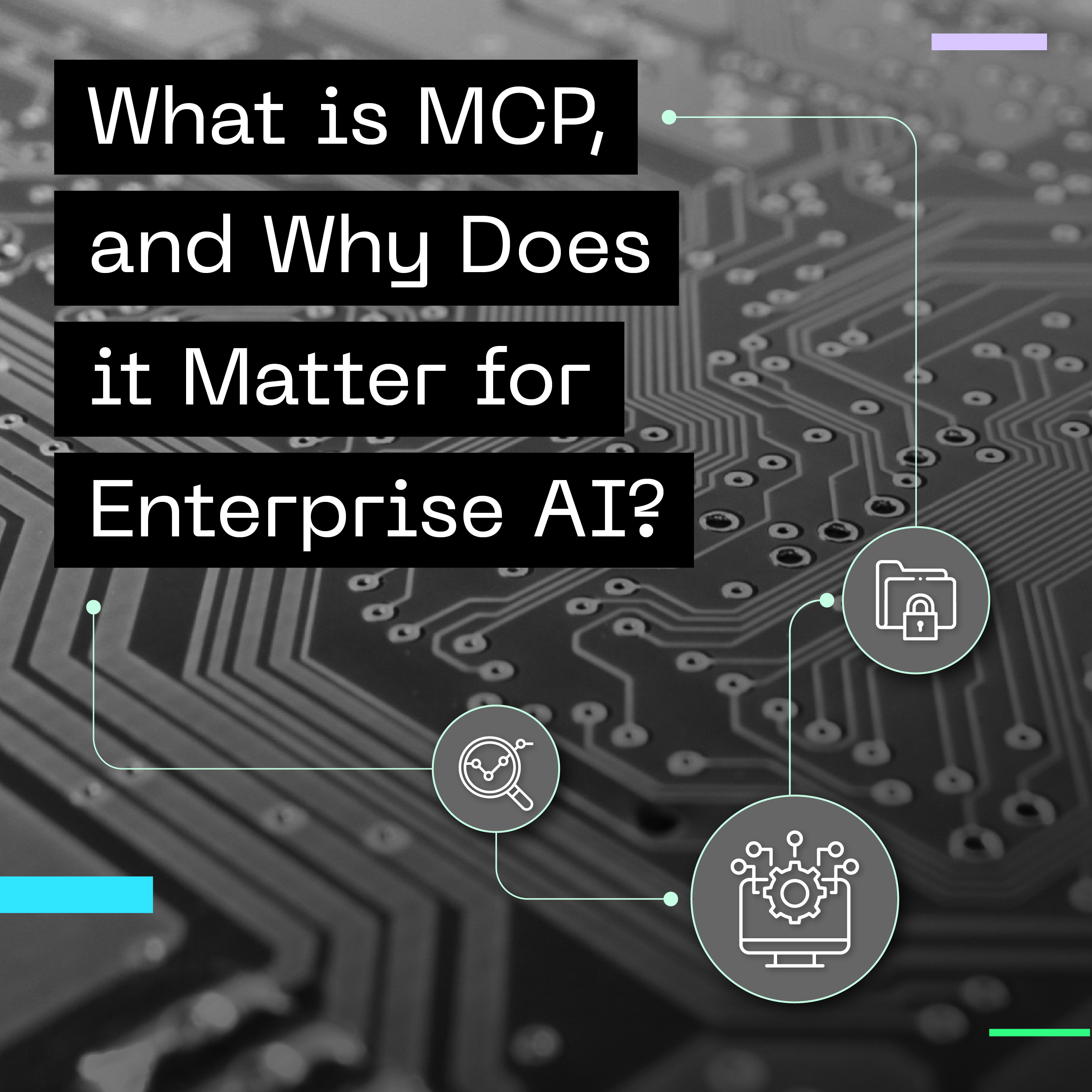

If you've spent any time with AI tools lately, you've probably noticed they're good at reasoning through problems and summarizing information. What they're not great at is knowing anything specific to your organization. An LLM like Copilot or Claude only knows what it was trained on. It can't pull your latest headcount numbers, look up something in your HRIS, or check whether a given person should have access to compensation data. It's working in a vacuum, disconnected from the live systems where your actual work happens. That’s the problem MCP was built to address.
What is MCP?
Model Context Protocol, or MCP, is an open standard that gives AI tools a common way to connect to external data sources and applications while a conversation is happening. When we say "protocol," we mean a strict, agreed-upon set of rules for how two separate computers or programs format text to talk to each other. A simple way to think about MCP is a universal adapter for AI. Just like a travel adapter allows your devices to plug into different outlets around the world, MCP allows AI tools to securely connect to systems, data, and business context organizations already rely on.
Why MCP Is Only Half the Battle
MCP solves a major problem: it connects your organization's data to the AI. But connection alone is actually not enough. Pointing an AI tool at your enterprise data through MCP does not automatically mean the data it finds is clean or trustworthy. Before the AI can use that data, it has to be unified, governed and operating off universal definitions. Unfortunately, workforce data is spread across so many systems (e.g. HRIS, ATS, payroll systems, and operational databases) that that is rarely the case. The AI can't give reliable answers to workforce questions until the underlying data foundation is cleaned up.
For example, getting a reliable answer to something as basic as headcount requires effective dating, historical tracking, and shared definitions that hold up when HR and Finance are both looking at the same number. That's not the default state of your workforce data, and MCP alone doesn't accomplish it. MCP just creates a path. What has to exist on the other end of that path is a data foundation that has already done the hard work of structuring, governing, and preparing data so it is ready to be used.
How One Model Finishes the Job
One Model for Enterprise AI ensures that your enterprise AI tools access properly governed, unified workforce data through our data mesh architecture and MCP. When someone asks a workforce question inside ChatGPT, Claude, or Copilot, they get a fast, accurate answer that respects their role-based permissions and draws from a single connected view of data, not a spreadsheet someone exported last Tuesday. One Model is the foundation that makes this possible. We do the structuring, modeling, and preparation so the data is analytics-ready before it reaches an AI model. It provides standardized definitions, effective dating, historical tracking, and reconciled views across HR and Finance.
One Model enforces role-based access controls and domain-level permissions on every query, so sensitive workforce data stays in governed systems rather than spreading into unmanaged environments where visibility disappears. HR leaders now get answers in tools they already use, data and analytics teams retain control over what gets exposed and to whom, and organizations can move from experimenting with AI to actually operationalizing it without trading speed for trust.
See It In Action
We recently hosted a webinar walking through how One Model for Enterprise AI works in practice, including a live look at MCP connections, governed access, and the kinds of workforce questions you can answer. Watch the session or explore this page to learn more.
Want to learn more about One Model?
