


 Overview
.svg) One AI
One AI
 Data Mesh
.svg) One AI Assistant
One AI Assistant
 Data Stories
 Enterprise AI
 One AI Data Intelligence


 Overview
.svg)
 Employee Engagement
.svg) Talent Retention
Talent Retention
-1.svg) HR Dashboards
HR Dashboards
 Succession Planning
.svg) Talent Acquisition
Talent Acquisition
 Workforce Analytics
 Why One Model
-2.svg) Whitepapers
Whitepapers
 Blog
Blog
-2.svg) Events & Webinars
Events & Webinars
.svg) Product Innovation Blog
Product Innovation Blog
-1.svg) Roles in People Analytics
Roles in People Analytics
 Contact Us
-3.svg) Partners
Partners
 About Us
-3.svg) Careers
Careers
-1.svg) News
News
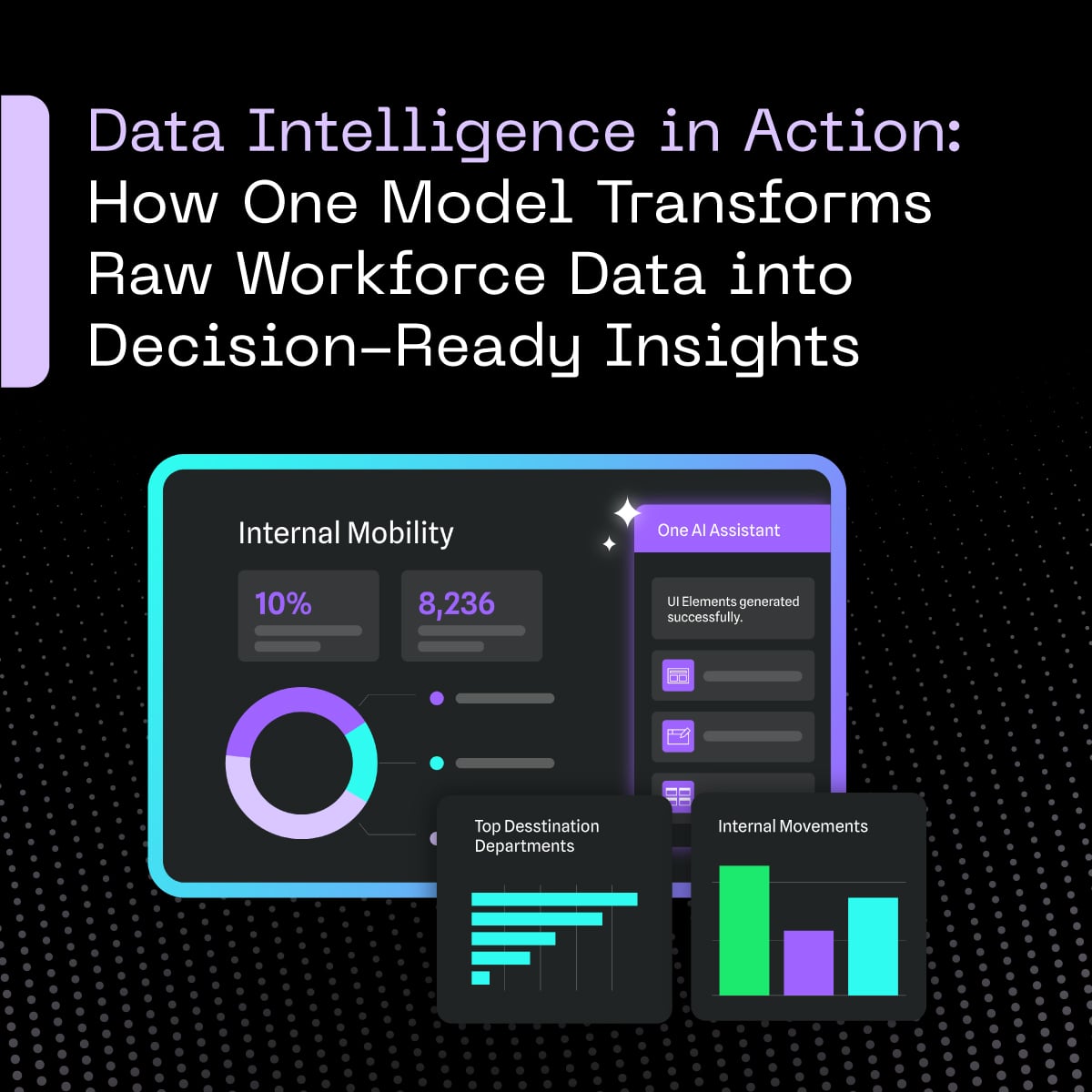

We’ve all lived some version of this nightmare: You walk into a high-stakes meeting. Someone pulls up headcount; someone else brings a completely different number. Suddenly the conversation isn't about strategy. It's an argument over whose data is right.
The problem usually isn’t bad data; it's scattered data. Your HRIS sees things one way, your ATS sees another, and your compensation tool disagrees with both. Unifying these systems used to take months of manual data engineering. Until Data Intelligence from One Model.
At CultureCon’s 2026 AI Summit, Hayley Bresina revealed how Data Intelligence, our proprietary data modeling tool, elegantly solves this problem, outlining everything you can achieve with it. Read on to get a clearer understanding of just how Data Intelligence works.
Step 1: Ingesting Raw Systems & Connecting the Dots
The first step to tame your data chaos involves pointing our AI at those disparate workforce data sources. Sources like Workday, SuccessFactors, Oracle, Greenhouse, survey platforms, badge swipes, and ad-hoc spreadsheets are all collected. The platform ingests the raw data, breaking down system silos.
By connecting these systems, you make each one exponentially more valuable. It enriches the type of analysis and insight you can yield from the data you always had. For example, while your HRIS provides baseline headcount, connecting it to your ATS links the recruitment pipeline to actual retention outcomes. Layering in compensation and performance data suddenly reveals whether top talent is being equitably rewarded. The broader the data ecosystem, the more intelligent the corporate insights become.
Step 2: Building the Configuration Plan
Before a single line of code is executed or a database table is modified, Data Intelligence maps out a transparent plan of the environment it intends to build. This plan explicitly outlines:
- Required data transformations.
- The exact tables and metrics to be created.
- How disparate data elements will link together consistently.
Instead of letting the AI build by itself and crossing your fingers, this step uses proven logic and structural patterns to map out the work deterministically.
Step 3: Pausing to Let a Human Validate
True data intelligence requires human guardrails. Once Data Intelligence generates the configuration script, the workflow pauses for human validation.
A senior data engineer meticulously reviews the AI-generated plan to ensure accuracy, compliance, and alignment with your specific business logic. This checkpoint ensures that while AI does the heavy lifting, human expertise maintains strict control over the underlying data architecture.
Step 4: Rapid Foundation Building & Infrastructure Deployment
Upon human approval, the data foundation build begins in real time. The platform rapidly constructs the critical data infrastructure that standard data lakes lack–specifically, the semantic layer, calculations, and permissions mapping.
In the presentation, Data Intelligence successfully models seven years of raw Workday and Greenhouse data–standing up over 1,000 components–in roughly 15 minutes. Without a sophisticated data platform like One Model, a deployment of this scale usually takes engineering teams weeks to months of tedious manual labor to build.
Step 5: Pressure Testing the Model in Plain-Language
Modeling data quickly is useless if no one understands how the final model works or makes decisions. Non-technical users need to be able to understand and pressure test it. The platform accounts for that, translating its architecture into an interactive living data map.
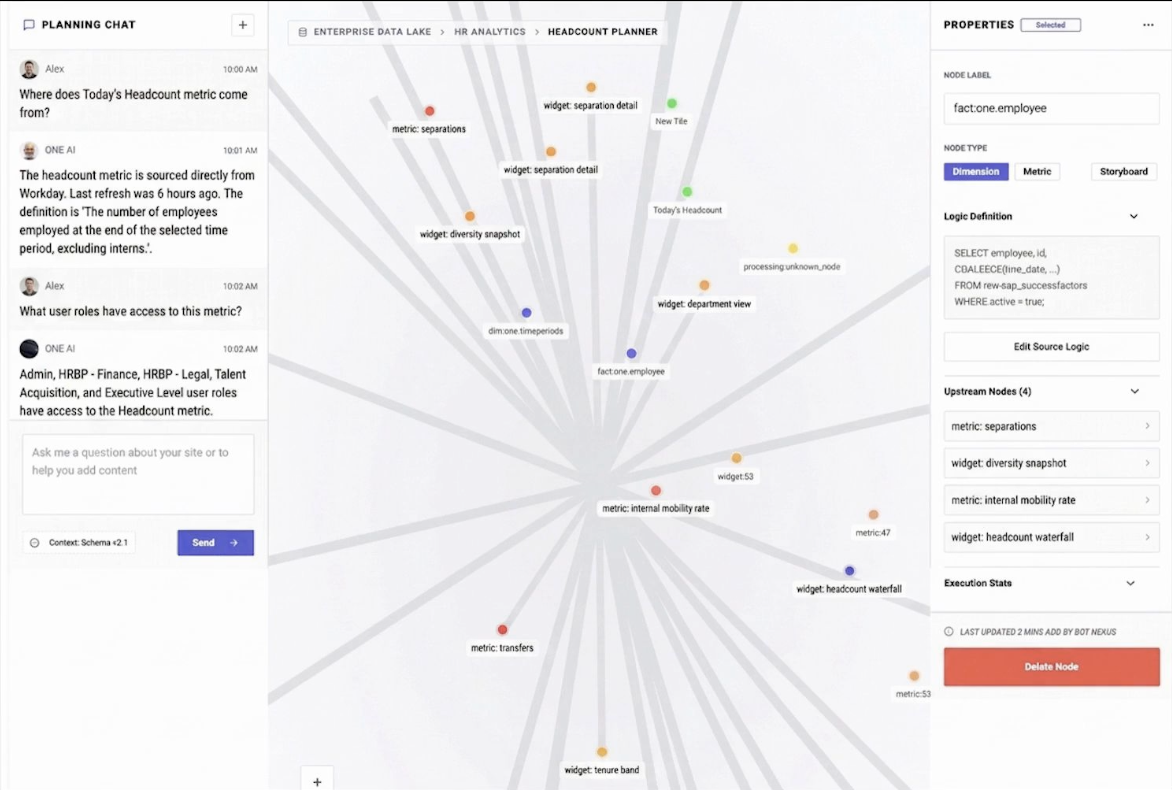
Users don’t need to parse code or hunt down data engineers to verify how the model landed on a number. Instead, they can query the model in plain English, with questions like:
- “Where does the 'today's headcount' metric pull from?”
- “Is there custom logic layered on top of this Workday data?”
- “Who has permission to view this specific salary bracket?”
The system instantly visualizes the data lineage, definitions, and security policies, driving radical transparency and fostering real executive trust.
Step 6: Conversational Analytics and Dynamic Storytelling
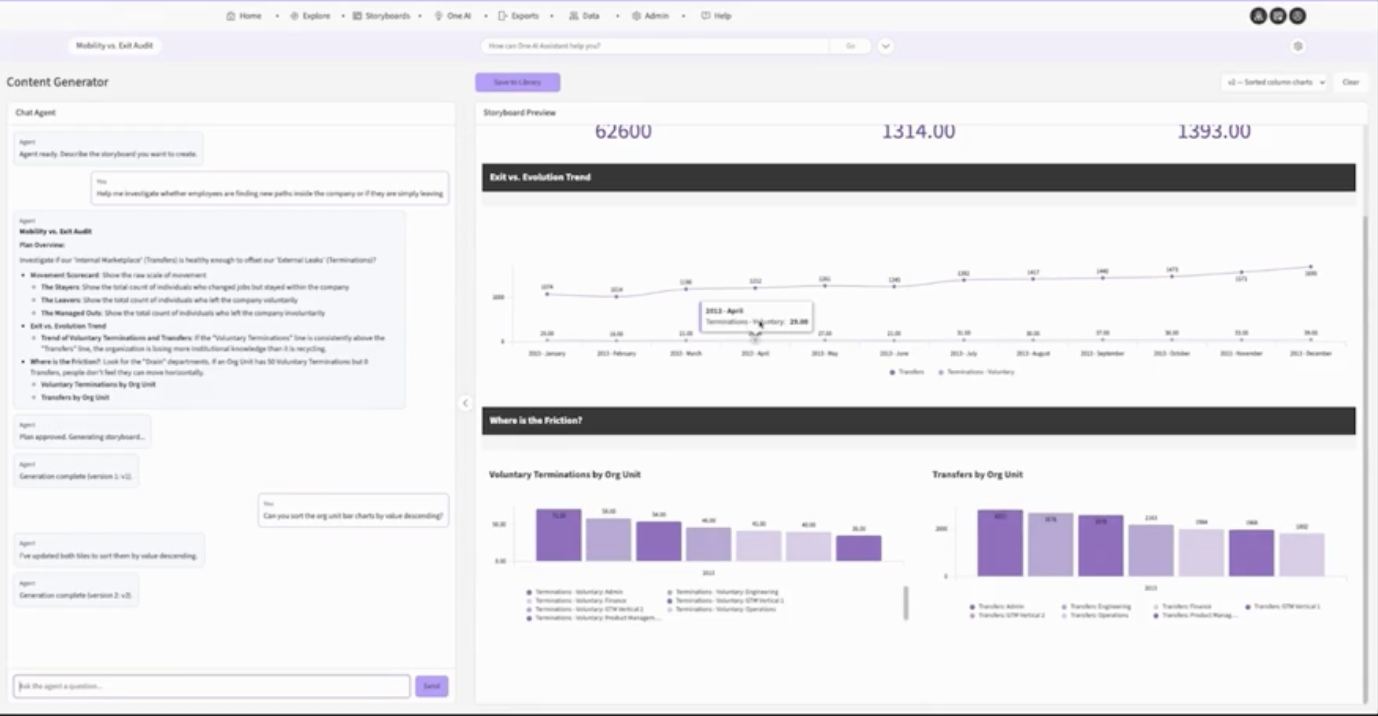
With the trusted foundation established, the final operational step is turning data into narrative through the storyboards.
Users simply describe what business challenge they want to explore, like internal mobility pathways vs. external attrition, and One AI generates a tailored dashboard.
These dashboards offer:
- Human-AI Collaboration: The AI asks clarifying questions (e.g., Are we looking at the fiscal or calendar year?) and explains why certain visuals belong together.
- Layout Control: Outputs can be easily edited. Users can reshape entire presentations, extend time periods, swap metrics on every chart, update colors and moving legends.
- Version Comparison: The interface is a dynamic workspace, where builders can compare iterations, revert changes, and perfect the narrative before publishing.
Step 7: Carrying That Governed Data to External AI Tools
Data Intelligence isn’t trapped inside our platform. The final stage of the One Model workflow, for those who use Enterprise AI, is extending the deeply governed "source of truth" we’ve created to the external AI tools that your executives use daily. This is accomplished with an MCP server.
If a business analyst is working inside an LLM like Claude to run a workforce scenario, the MCP Server allows Claude to query the One Model foundation directly.
Crucially, our data foundation strictly enforces the user's pre-mapped One Model data permissions. The analysis remains perfectly accurate, secure, and grounded in your company's precise analytical definitions, preventing the generic or hallucinatory answers common to isolated AI models.
Ready to Shift from Data Chaos to Decision-Ready Intelligence?
The true value of AI lies in removing the operational drag between having a question and finding a trusted answer. No AI accomplishes that for people data better than One Model. By leveraging an automated, human-verified pipeline, HR teams can transition from fragmented data chaos to a streamlined, decision-ready ecosystem.
Answer Your Hardest Data Questions with One Model
Ready to see this step-by-step process applied to your own tech stack? Bring us your messiest workforce question, the metric your departments can never agree on, or the reporting workflow that takes your team entirely too long to build.
