

 Overview
 One AI
 Data Mesh
 One AI Assistant
 Data Stories
 Enterprise AI
 One AI Data Intelligence


 Overview

 Employee Engagement
 Talent Retention
 HR Dashboards
 Succession Planning
 Talent Acquisition
 Workforce Analytics
 Case Studies
 Whitepapers
 Blog
 Events & Webinars
 Product Innovation Blog
 Roles in People Analytics
 Contact Us
 Partners
 About Us
 Careers
 News
 Why One Model

What if your next analytics project took days, not months?
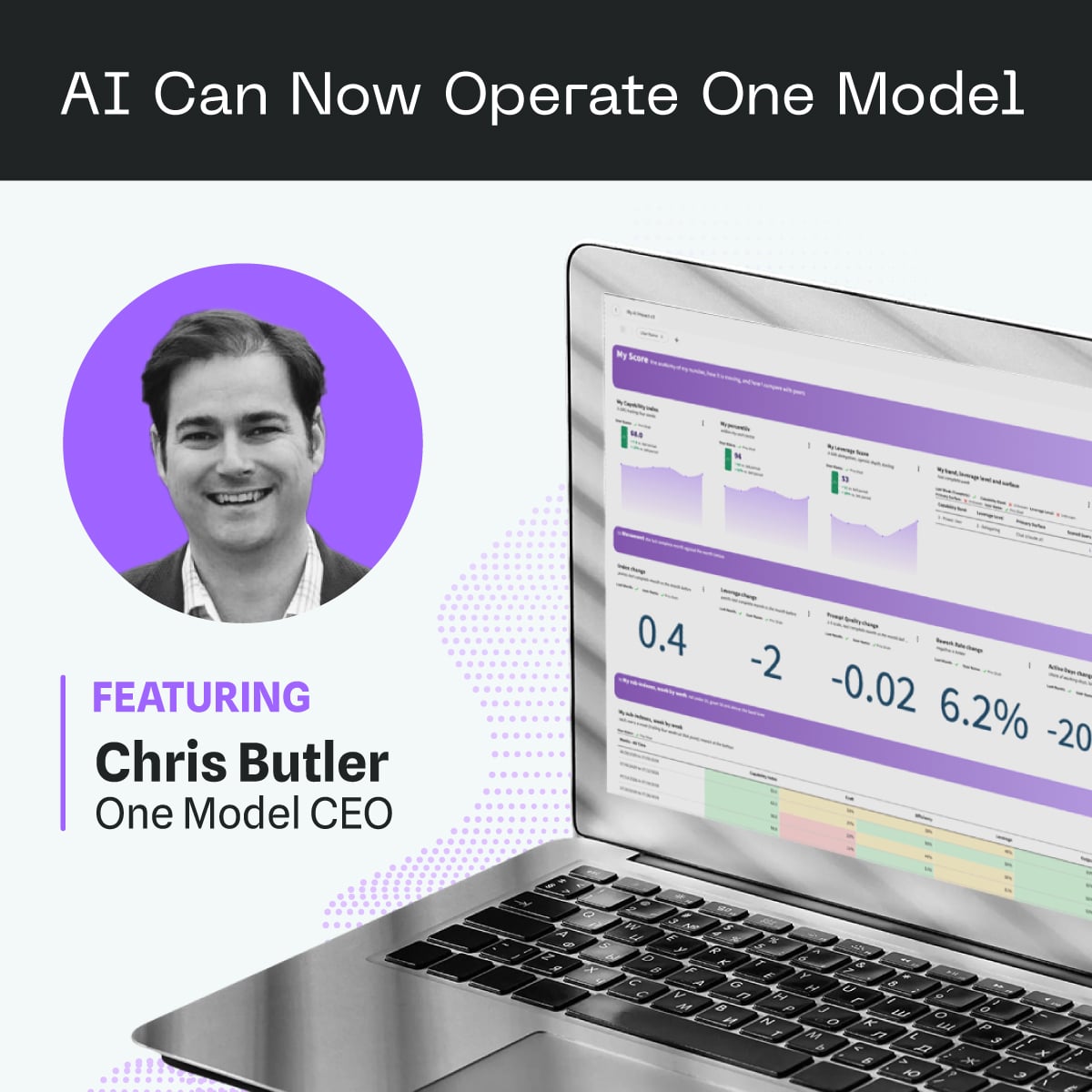
For the last several years, we have been opening up the services inside One Model so that AI can operate the platform. That includes our own One AI Assistant and the AI tools you already use, such as Claude, ChatGPT and Copilot. We have released those services steadily and reworked One AI so external AI can run One Model well.
That work has reached a point where it changes how analytics gets built. A growing share of what you used to configure by hand, an AI can now do alongside you, and that share grows with each release.
What's changed
People analytics has always been limited by three things: knowing what to build, having the expertise to build it, and the time the build takes. Our own builds show it. Each one needed research, data modeling, metric definitions and content, all built by hand, and each took time.
AI changes that. It can research a domain, plan the build, create the integrations and the data model, define the metrics, build the storyboards, validate the result, and flag issues that need human expertise.
When expertise and build time stop being the constraint, access to data becomes the constraint.
I expect many people analytics teams to spend less time wrangling and more time working with the business to get access to the data that matters to them.
What it looks like in practice
Ask your AI for what you need and One Model builds it, on top of your modeled workforce data. With the right role-based permissions, your AI can:
- Build and change content. Create or reconfigure dimensions, build new metrics and construct new storyboards, including drill-throughs, to your definitions.
- Take on a new subject area. Research the domain, plan the build in One Model and carry it out step by step.
- Bring in new data. For teams that want to go further, operate One Model's integrations to load new data and update the data model so it is ready for analysis.
-
Check its own work. Validate the data and the results against the definitions the build was based on.
In my first week with these services in place, I used AI to build four analytics modules in seven days. The AI researched each domain and planned the build in One Model. It built the data integrations, the data model, the metrics and the storyboards, and validated the data. The AI worked through One Model to create and validate thousands of lines of new processing script, hundreds of metrics and dimensions, and dozens of storyboard pages.
In another scenario, I asked for a CFO view. The AI worked out what a CFO would want to see, chose the financial and productivity metrics, built the analysis behind each area where those numbers could move, and assembled a one-page storyboard with a structured storyline to walk through. I ran it live during a demo and it took about 15 minutes. Our CFO made a few tweaks and now uses it in active discussions.
These are demonstrations, not guaranteed timelines. They show what changes when building stops being the bottleneck.
How it works is fundamentally different
Until recently, an AI that wanted to change One Model had to operate the browser like a person, clicking through screens. That was slow and error-prone. With the services we have built, the AI works directly: it scripts the changes it needs, runs them against One Model, and checks the result. In my experience, the difference in speed and accuracy is night and day.
You can work through One Model's AI Assistant, the AI tools your company already uses, or a mix of the two. If you want to connect via an MCP server, it’s a simple two-step process: connect your AI to One Model’s MCP service and install the One Model skill, which teaches your AI how One Model works and how to use it well. There will be ongoing releases to the platform that improve and extend the service available to the AI, and we will keep our skill updated to reflect these changes.
In the current phase, I recommend that you also use browser access with your AI (e.g., Claude in Chrome logged in as you), which is capable of operating and directly using One Model. This has the added benefit of helping with visual design of storyboards because it can actually see and iterate a design.
Skills will use One Model as much as possible and fall back to browser use where required based on your request.
Why it works on One Model
Plenty of platforms can be operated by AI, and I expect most to be soon. What matters is what the AI has to work with. One Model brings a point of view on the content: we curate the data, model it over time, define how it connects, and keep a library of metrics and definitions.
When your AI builds in One Model, it builds on that foundation instead of starting from raw tables.
That is why a request like “attrition by manager hierarchy over three years” means the same thing as “three-year turnover trends across every level of your management chain” every time you ask. The organization is modeled as it stood at each point in time, not as it looks today, and the definitions are consistent wherever they are used. Nobody has to recreate that work for each new build.
Speed needs guardrails
More capability in more hands means more content, and more room for noise and clutter. If you can build a storyboard in minutes, your instance can grow faster than you can review it. I recommend keeping an eye on usage statistics, reviewing what you have delivered on a regular basis, and using your AI to help maintain and clean up your instance as well as build it.
Validation matters as much as speed.
What it means for your team
Less time building, more time solving. Our customers have long told us they want control over their data and the ability to spin up new content quickly. We have always worked to put both in your hands, and this accelerates your ability.
-
People analytics teams create their own metrics, dimensions, and storyboards without waiting on IT or data engineering, and spend their time on analysis instead of data wrangling.
- HR business partners and CHRO-level leaders can ask questions through their own AI and have content built around exactly what they asked, instead of adapting what already exists.
- Our Customer Success team is using the same tooling, so we expect to deliver more capability and content, faster. As they work with it they will share how they got there, including the prompts and flows they used, so you can do the same.
The same foundation sits underneath all of it: One Model's governed workforce data, with the definitions and context that make answers trustworthy.
See it for yourself
Book a demo or talk to your Customer Success Advisor.
Examples are from One Model demonstrations and are illustrative. Timelines and results vary by organization.
