

 Overview
.svg) One AI
One AI
 Data Mesh
.svg) One AI Assistant
One AI Assistant
 Data Stories
 Enterprise AI
 One AI Data Intelligence


 Employee Engagement
.svg) Talent Retention
Talent Retention
-1.svg) HR Dashboards
HR Dashboards
 Succession Planning
.svg) Talent Acquisition
Talent Acquisition
 Workforce Analytics
 Why One Model
-2.svg) Whitepapers
Whitepapers
 Blog
Blog
-2.svg) Events & Webinars
Events & Webinars
.svg) Product Innovation Blog
Product Innovation Blog
-1.svg) Roles in People Analytics
Roles in People Analytics
.svg)
 Contact Us
-3.svg) Partners
Partners
 About Us
-3.svg) Careers
Careers
-1.svg) News
News

Imagine standing in front of your CFO, presenting a critical plan that calls for restructuring three major business units. You click to the next slide, showing a sharp spike in predicted turnover for your top engineering talent over the next two quarters.
The CFO leans forward. "Where is that number coming from? How are we calculating turnover risk for teams that were just merged?"
You pause. The honest answer is that you don't know. Your people analytics software calculated it behind a digital curtain. You can't open the hood, you can't adjust the math to account for the merger, and you can't see which variables the system weighted most heavily.
You're forced to say, "That's just what the system spit out."
Just like that, trust evaporates.
What Is “Black Box” Software?
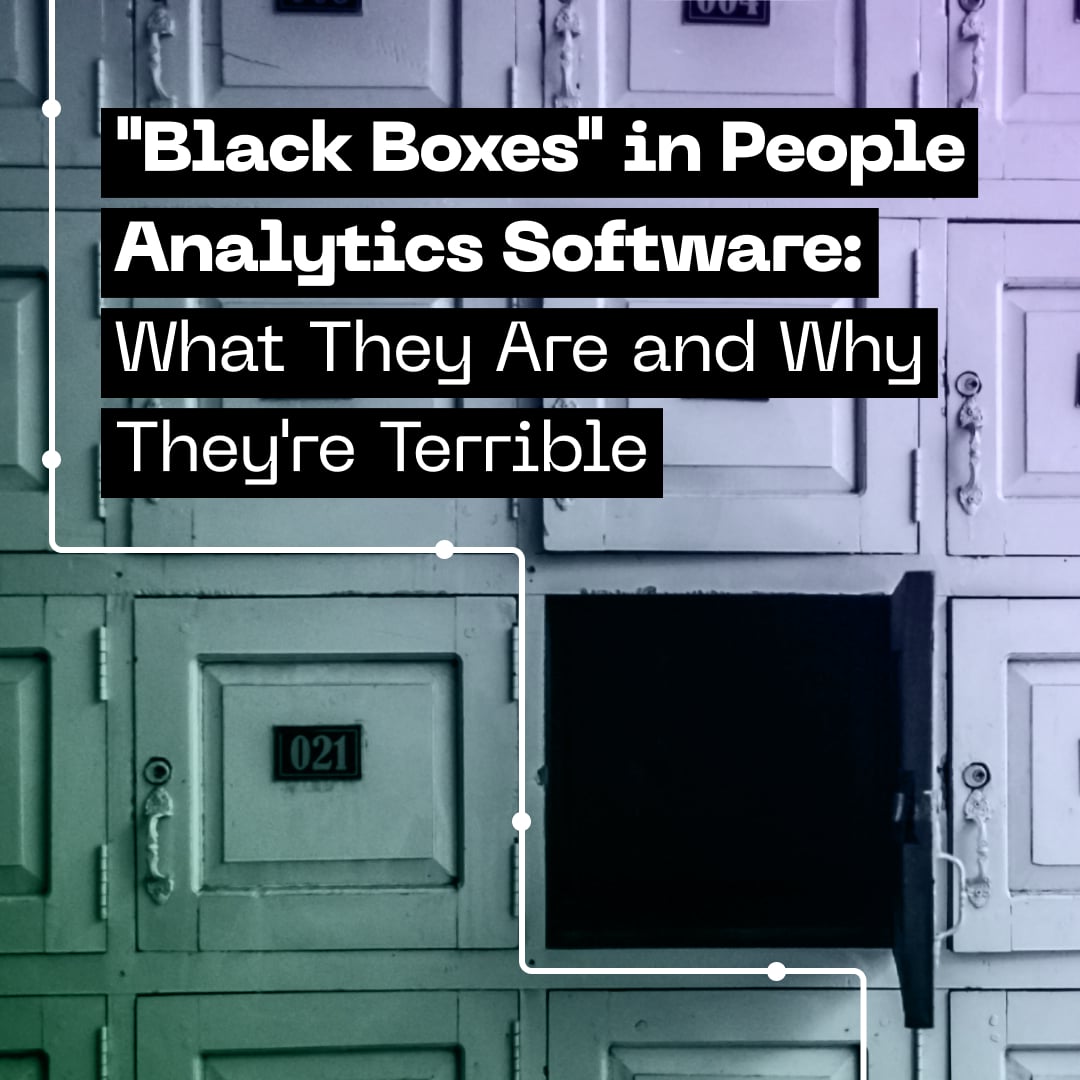
This happens every day in HR departments relying on what we call “black box” people analytics software. “Black box” means the software vendor runs your workforce data through proprietary, hidden logic that you can't inspect, question, or customize. They hand you an answer and expect you to accept it on faith. That isn't just frustrating. It's dangerous for your business. Some top vendors work this way.
In this article, we’ll break down what black box AI actually means for People Analytics, and how explainable AI puts control back where it belongs, in your hands.
Why Is Black Box AI a Problem for HR and People Analytics?
HR teams deal with sensitive human decisions, compensation budgets, and long-term organizational strategy. Running those operations on vendor-locked, closed systems introduces major friction across three key areas.
1. It OverlooksYour Custom Business Logic
Does every business calculate headcount or attrition the same way? Of course not. A global manufacturing firm tracks active employees differently than a fast-growing tech startup.
When a software provider forces you into hardcoded, proprietary logic, they lock you into their assumptions about your company. You can't tweak formulas, change metric definitions, or account for structural shifts like acquisitions. If your leadership team disagrees with how the software defines "voluntary turnover," you have no way to fix it inside the tool. You're stuck.
2. Algorithmic Bias Creeps in Unnoticed
Workforce decisions carry heavy legal and ethical consequences. When a black box AI model uses hidden rules to flag high-potential employees or predict who might quit, it can quietly amplify bias. Without full visibility into variable weightings, you can't check whether the algorithm relies on faulty proxies that violate compliance standards, labor laws, or your internal policies.
3. Credibility Burns Down Fast
Executives don't make multi-million dollar headcount decisions based on trust alone. They want proof. If an analytics team can't explain the mechanics behind a risk score, executives could simply ignore the data and fall back on gut instinct. You end up with a software that breeds decision paralysis, rather than eliminating it.
The Fix: Explainable AI and Data Lineage with One Model
To escape rigid, closed-lid software, organizations need clear AI explainability paired with automated data lineage tracking.
Think of data lineage like a clear digital audit trail. It tracks where your information started (like your HRIS or ATS), how it moved through your systems, and every transformation it underwent before reaching an AI model or executive report.
When you combine data lineage with complete data transparency, you can:
- Tailor the Math: Adjust rules, metrics, and business logic so they reflect your actual operations instead of a vendor's default settings.
- Audit Everything: Trace data from raw source records straight through to final dashboards without missing a step.
- Maintain Granular Governance: Keep strict control over access, security rules, and compliance standards.
By switching to “glass box” data orchestration platforms like One Model, teams get a single source of truth without handing over control of their underlying logic.
When HR leaders, data analysts, and executives can look under the hood of their software, confidence naturally follows. AI transparency bridges the gap between automated insights and real-world execution.
Teams looking to modernize their tech stack should look for open, fully inspectable systems by checking out an Enterprise AI product page or connecting with a proven People Analytics Leader.
One Model Is a Champion of Explainable AI in People Analytics
We operate this way because we fundamentally champion explainable AI. Explainable AI is artificial intelligence built so humans can clearly see, trace, and understand how a system arrived at its output.
Instead of treating software like an oracle, explainable AI lets you look at the underlying blueprint. In HR and People Analytics, it opens up the calculations behind your predictions. You can see how raw employee records move through the system, which factors drive a specific turnover score, and how every key metric gets defined.
When you use explainable models, you aren't stuck accepting a vendor's guesswork. You get total visibility into the math so you can audit the logic, adapt it to your company's actual structure, and defend the results to executive leadership.
Ditch the Black Box
Opaque analytics vendors try to pitch hidden logic as a feature that saves you time. In reality, it strips away your authority, locks up your data, and leaves you unable to answer basic questions from leadership.
Systems like One Model, built on a decade of data orchestration, treat transparency as the foundation, not an afterthought.
If your current People Analytics software won't let you see or change its internal logic, your strategies are built on thin ice. Moving to explainable AI and transparent data pipelines ensures your team keeps full ownership of its metrics, models, and strategic decisions.
Ready to see what explainable AI tools like One Model can do for your business?
Connect with us today!
FAQs
Explainable AI is AI designed so people can understand how and why a model produced a particular output, prediction, or recommendation.
Black box AI describes AI systems where users can see the inputs and outputs but have limited visibility into how the system reached its conclusion.
HR decisions involve sensitive workforce data and can affect people. Explainability gives teams greater visibility into the factors and methodology behind AI-generated insights.
AI transparency is the ability to understand how an AI system operates, including the data, models, logic, controls, and processes involved in producing its outputs.
Data lineage tracks where data originated, how it moved through systems, and how it was transformed before being used in analytics or AI.
